
‘Food is love’: With SNAP payments in limbo, New Englanders are stepping up to help one another
Restaurants, neighbors, and community organizations are filling the gap as the federal shutdown continues and the Trump administration fights to avoid fully funding food aid
By Christopher Gavin and Katie Muchnick
Originally published in The Boston Globe, 11/7/2025
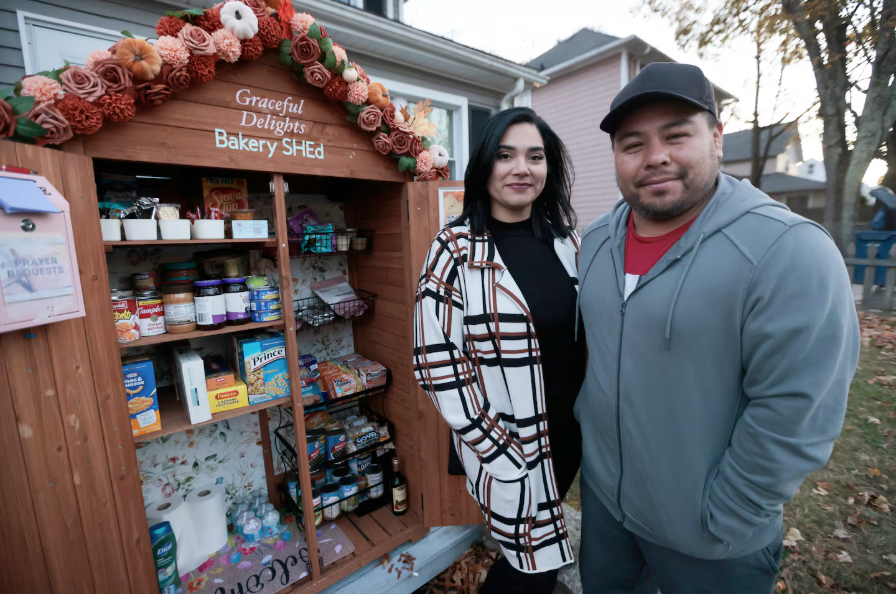
WARWICK, R.I. — Britnie Aldana-Hernandez is a mother of three and a federal government worker who has gone nearly a month without a paycheck.
The family still has income from her husband’s job, but Aldana-Hernandez, a service representative for the Veterans Benefits Administration, acknowledged this week her family is starting to feel the loss of her income amid the government shutdown.
“I have a mortgage to pay,” she said. “Bills don’t stop. Day care costs are through the roof.”
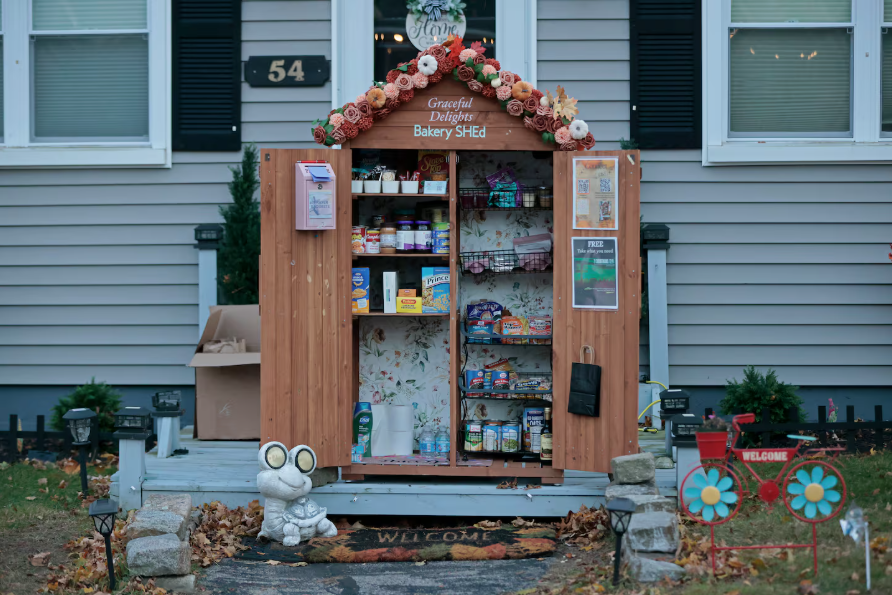
Still, she and her family transformed a small shed in the front yard of their Warwick home typically used for Aldana-Hernandez’s cottage bakery business, Graceful Delights, into a pantry stocked with canned food and other necessities.
With donations from a few neighbors, they’re offering the items for free to whoever may need them after the Trump administration stopped fully funding Supplemental Nutrition Assistance Program on Nov. 1.
Aldana-Hernandez said at least her family still has an income. Not everybody does, she said.
“One day I’ll be in need, and the community will do the same,” she said.
With SNAP benefits in limbo, restaurants, businesses, community organizations, and people around New England have stepped up, giving away food, money, and their time to make sure their neighbors in need will not go without.
Restaurants are offering free meals to SNAP recipients and federal employees. Donations to food banks have soared.
Over the past week, the Rhode Island Community Food Bank has purchased more than 800,000 pounds of food, according to CEO Melissa Cherney.
“All of that is because the community has stepped up with donations,” Cherney said Thursday, noting the food bank also attracted more than 1,000 new donors. “It’s corporations, it’s foundations, it’s individuals.”
During its annual food donation drive on Nov. 1, Scouting America’s Narragansett Council, which encompasses Rhode Island and parts of Connecticut, and Massachusetts, collected more than 292,000 pounds of food — an all-time high since the event began more than 35 years ago, according to council CEO Tim McCandless.
“All of [the scouting units] that we have heard from said the response was far better,” McCandless said. “They were seeing one and a half to two times [what they saw] last year.”
The outpour comes as the flow of SNAP benefits remained in limbo on Friday morning.
On Thursday, a federal judge in Rhode Island ordered the federal government to provide recipients with their full allotments for November, after the Trump Administration said it would fund a partial amount for the month.
The administration moved to block the judge’s order on Friday.
SNAP serves 42 million of the nation’s most vulnerable people, including low-income and disabled residents. In Massachusetts, about 1.1 million people rely on SNAP benefits, or 16 percent of the state’s residents. Approximately 145,000 Rhode Islanders rely on SNAP payments to make ends meet.
“The lack of SNAP benefits and food stamps for people right now is impacting way more people than we realize,” said Kevin O’Donnell, chef and owner of Giusto in Newport, R.I., which has expanded its annual food donation program amidst the crisis.
Seoul Kitchen, a restaurant with locations in Leominster and Westford, Mass., has been offering free takeout to federal employees and SNAP recipients.
“The demand was much, much larger than we anticipated,” said owner Jae Chung. “There’s a lot of people suffering out there.”
Cecelia Lizotte, owner of Suya Joint, which has locations in Roxbury, Mass., and Providence, said the impact of the SNAP shutdown hit her after she learned some of her employees rely on the payments to get by.
“To hear that, I’m like, ‘All right, what can we do? How can we help?'” Lizotte said.
Both restaurants are now offering free meals on Monday afternoons — hours when they’re typically closed. But Lizotte said she and her staff have been eager to volunteer their time for the cause.
“They’re like, ‘Yes, please. We will be more than happy to volunteer … time off to come and package meals, spread the word,'” Lizotte said.
Rhody Roots, a restaurant in Warren, R.I., is offering 100 free meals for children a week, according to co-owner Cassie Brimmer.
“A lot of us have been on government-assisted programs in this industry,” Brimmer said. “We fully understand.”
In Boston, Little Cocoa Bean Co. at the Children’s Museum is offering free meals to income-constrained families. The first customer was a senior who ordered a sandwich, Founder and CEO Tracy Skelly said.
“There’s no world in which anyone, but especially our seniors who have paid their dues … should get to a point where they have to come into a kids cafe for a free meal,” she said.
Blacker’s Bakeshop in Newton, Mass., is hosting free bread tables on Wednesday evenings and Sunday afternoons for people on SNAP. The table is stocked with leftover challah from the bakery and community-sponsored loaves that customers can tack on to the end of their bills, said manager Rebecca Blacker. Customers donated 60 challah loaves before the first table day Nov. 2.
“You mess with our customers, you mess with us,” Blacker said. “Food is love and food is support. To take that away from someone is unthinkable.”
At the Little Compton Community Center in Rhode Island, staff have expanded the free lunch program for seniors from three days a week to five days a week, and increased the number of meals served from 80 to 100, according to administrative assistant Chris Clark.
The center asked for donations to help support the program, Clark said.
“People just were so generous and lovely,” she said. “Kind of gives you goose bumps.”
Still, that’s not the case for all organizations working to fill the gaps. The Elisha Project is a Pawtucket-based nonprofit that organizes drive-through distribution events, offering food, furniture, and a variety of necessities for those in need.
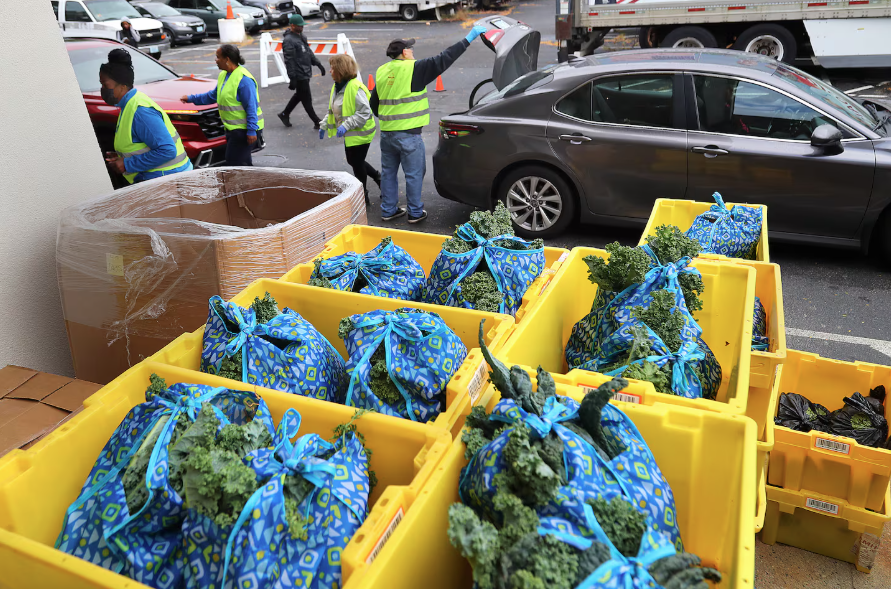
A single event usually serves about 500 cars — or about 1,000 families — said cofounder and CEO, the Rev. George L. Ortiz, Jr.
In Pawtucket on Nov. 1, workers served 600 cars across three hours beginning at 8 a.m. The line stretched “two miles longer than it’s ever been,” and volunteers were still turning people away later that afternoon, Ortiz said.
The first person in line had waited 12 hours to secure their spot, he said. More events are planned for Nov. 22 in Pawtucket and Dec. 6 in Boston’s Copley Square.
“The increase has been the demand, not so much any funding, because everybody’s tight, and nonprofits tend to, like anybody else, compete for monies,” Ortiz said.
Ortiz said he needs help from corporations and retailers.
“Instead of throwing away the stuff that gets returned, let’s build a partnership,” Ortiz said. “Let me put that into people’s hands.”
Cherney, at the Rhode Island Community Food Bank, said even the vast influx of food in the past week will only last so long: The food pantries it works with are serving triple the amount of people they usually do.
President Trump’s “One Big Beautiful Bill Act” is also slated to expand work requirements for SNAP recipients, she said. More than 13,000 people are expected to lose benefits as a result in Rhode Island alone, Cherney said.
“That’s going to hit us hard, and that’ll hit in February,” Cherney said. “And so we’re not out of the woods yet.”
Originally published in the Boston Globe.
Founded in 1982 and headquartered in Providence, RI, the Rhode Island Community Food Bank (“the Food Bank” or “RI Food Bank”) serves as the central hub for food distribution across its state-wide network of 137 member agencies/food pantries, ensuring that nutritious food reaches those who need it most. Through donations, federal programs, and community partnerships, the Food Bank works to improve the quality of life for all Rhode Islanders by advancing solutions to the problem of hunger.
The RI Food Bank is a 501(c)(3) non-profit organization. Your donation is tax-deductible as allowed by law.
Rhode Island Community Food Bank │ 200 Niantic Avenue, Providence RI 02907 │ (401) 942-6325 (main) │ rifoodbank.org