Hunger Action Month brings renewed commitment to increasing food access in Rhode Island
Commentary by Melissa Cherney
Originally published in Rhode Island Current, 9/3/2026

(Michael Salerno/Rhode Island Current)
Moving to Rhode Island from North Dakota, I often get asked about the differences between the two places. People say they’ve never met anyone from North Dakota before. They’ve never had a hotdish or a Scotcheroo. They’re curious about what would make me move from the Midwest to a coastal state that, on the surface, couldn’t be more different from where I grew up.
It’s true — the beaches of Rhode Island look very different than the prairie grasslands of North Dakota.
But as Hunger Action Month 2026 begins, and I just wrapped up my first year leading an extraordinary team at the Rhode Island Community Food Bank, it’s not the differences that stand out. It’s a universal truth for hunger relief advocates from Fargo to Foster: Hunger is something you experience; it’s not who you are.
It can affect anyone, and it is affecting too many of our neighbors.
The latest RI Life Index, a survey conducted by Blue Cross Blue Shield of Rhode Island and Brown University’s School of Public Health showed that the number of households reporting food insecurity more than doubled between 2020 and 2024. Add in last fall’s SNAP crisis, steadily rising food costs, high cost of living, and ongoing policy changes that threaten food access for even more families, and the need is truly greater than ever.
Those statistics aren’t just numbers; they represent real people and families. Hunger looks like people working full time who still can’t make ends meet. Young professionals who have no choice but to pay high rents. Seniors who have paid into Social Security, trusting that it would be there when they retire. Parents who skip meals, so their kids don’t miss dinner. Their dollars aren’t stretching as far as they used to, and an occasional trip to the local food pantry has become an essential monthly stopgap. The Food Bank and our network of 140 member agencies are struggling to keep up with demand.
It’s an unstable, unpredictable time for many families, and for many of us working in hunger relief.
And yet, it’s in these challenging moments that reveal what a community can accomplish together.
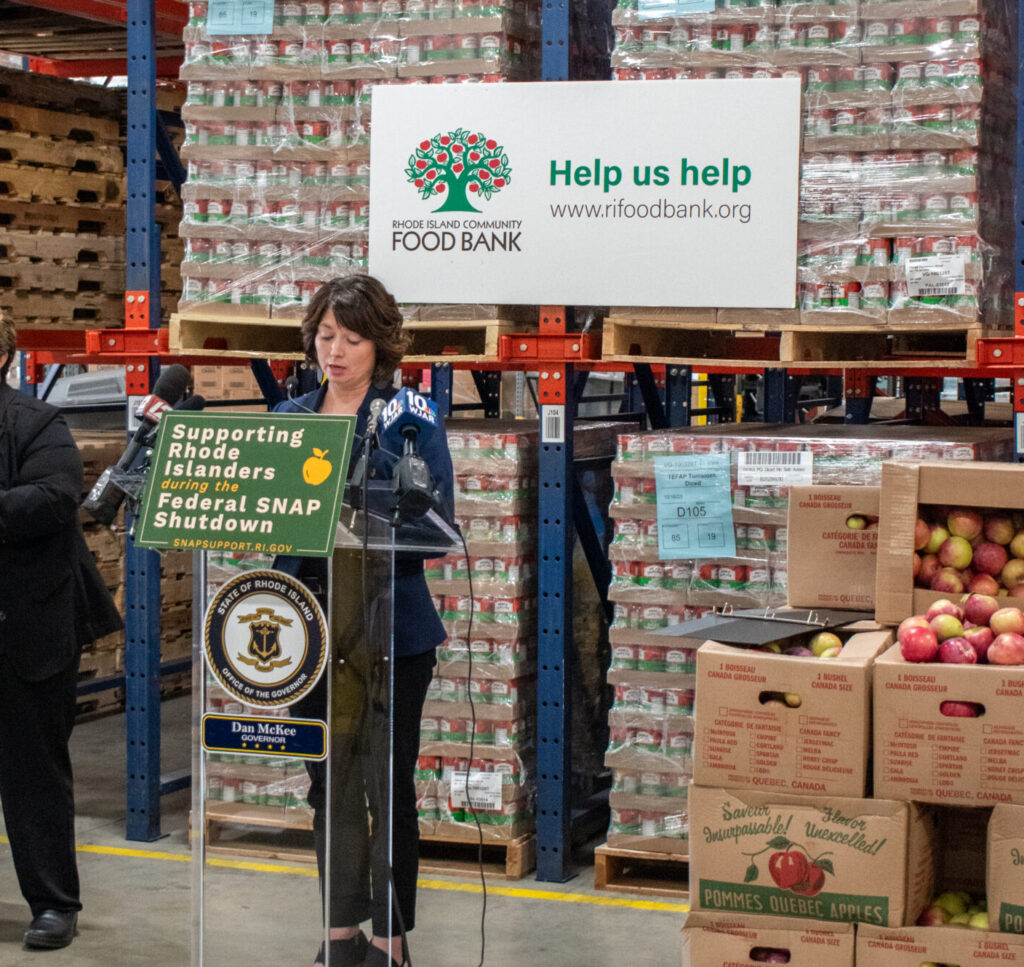
When SNAP benefits were delayed last fall, Rhode Islanders stepped up to help one another. Individuals donated, volunteers served, businesses and community organizations rallied, and the General Assembly increased funding for food purchases. Their response showed the compassion and collective strength of our state.
But responding to a crisis is not the same as solving it. We need a long-term solution that ensures reliable access to nutritious food, strong public policies, sustained investment, and action on the underlying pressures that force families to choose between groceries, housing, medicine and other necessities. Our response last fall showed what Rhode Island can do. Now, we must turn that spirit of collective action into a lasting commitment.
“It’s a universal truth for hunger relief advocates from Fargo to Foster: Hunger is something you experience; it’s not who you are.”
Because if there is anything that 20 years in hunger relief has taught me, it’s that no one organization, no one state entity, no one policy can solve this significant and complex issue. As Feeding America says in this year’s Hunger Action Month campaign, “assembly is required.” Real solutions are never built alone. Yet hunger is solvable.
And while I may still be a newcomer by Rhode Island standards, this past year has given me renewed optimism that it is here — 1,600 miles away from the farmlands where my work in this field began — where we can solve it.
– Melissa Cherney
Melissa Cherney is the chief executive officer of the Rhode Island Community Food Bank and serves as chair of the Policy Engagement and Advocacy Committee of Feeding America.
Founded in 1982, the Rhode Island Community Food Bank is a 501(c)(3) nonprofit organization that works to improve the quality of life for all Rhode Islanders by advancing solutions to the problem of hunger. The Food Bank serves as the central food distribution hub across a statewide network of 140 member agencies. Through donations, federal programs, and community partnerships, in 2026, the Food Bank distributed over 18.2 million pounds of food, 4.7 million pounds of which was fresh produce. The RI Community Food Bank is a member of Feeding America, the nation’s largest domestic hunger-relief organization.
The RI Food Bank is a 501(c)(3) non-profit organization. Your donation is tax-deductible as allowed by law.
Rhode Island Community Food Bank │ 200 Niantic Avenue, Providence RI 02907 │ (401) 942-6325 (main) │ rifoodbank.org